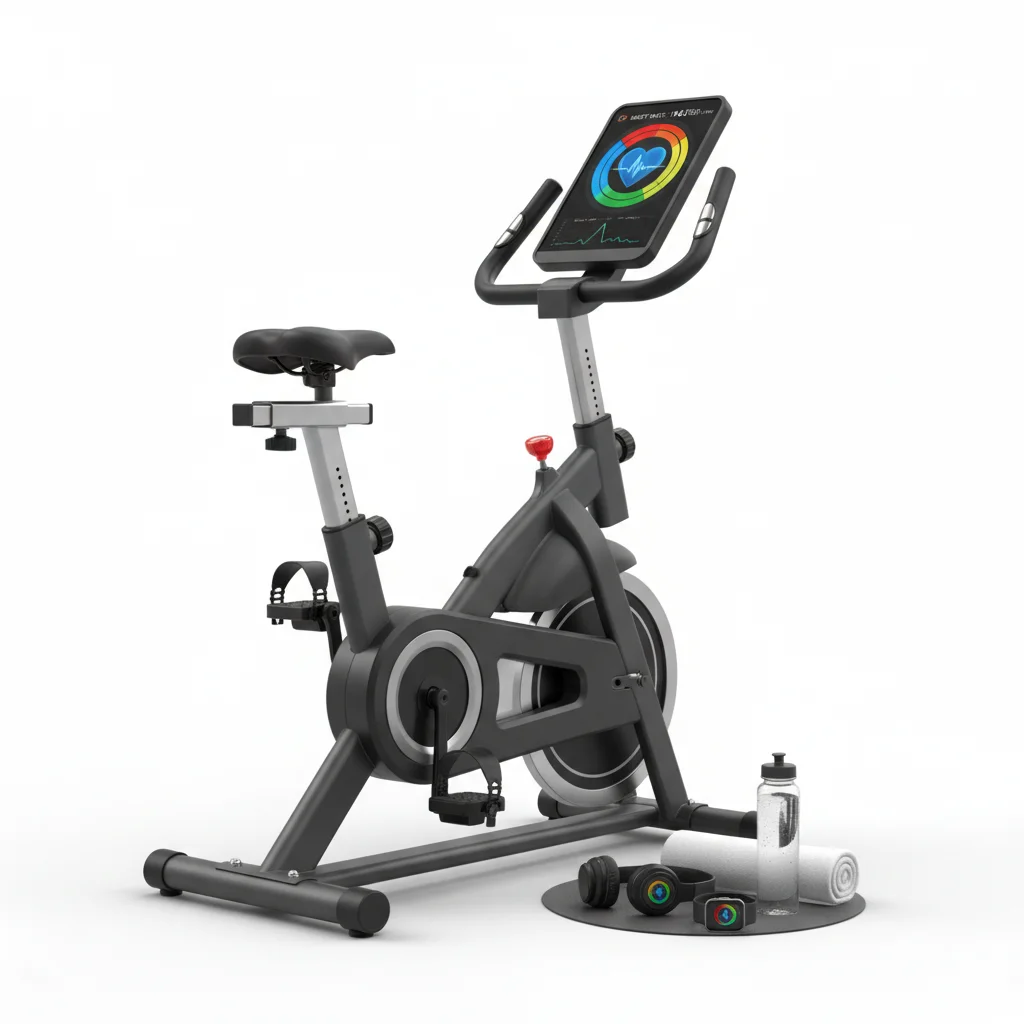
Understanding your exercise bike heart rate zones is crucial for optimizing your workouts and achieving specific fitness goals. There are five primary heart rate zones, each corresponding to a different intensity level and offering unique benefits, from fat burning to peak performance. By training within these zones, you can tailor your rides to maximize efficiency and results.
Understanding the Five Heart Rate Zones
The five heart rate zones are typically calculated as a percentage of your maximum heart rate (MHR). Your MHR is generally estimated by subtracting your age from 220. For example, a 40-year-old would have an estimated MHR of 180 beats per minute (bpm). Each zone targets different physiological responses.
- Zone 1: Very Light (50-60% MHR): This is a warm-up or cool-down zone, ideal for recovery and improving overall health.
- Zone 2: Light (60-70% MHR): The fat-burning zone, where your body primarily uses fat for fuel. Great for endurance and weight management.
- Zone 3: Moderate (70-80% MHR): Improves cardiovascular fitness and endurance. You’ll feel challenged but can still hold a conversation.
- Zone 4: Hard (80-90% MHR): Enhances anaerobic threshold and speed. This zone is challenging and you’ll find it difficult to speak in full sentences.
- Zone 5: Maximum (90-100% MHR): Short bursts of high intensity, used for interval training and improving peak performance.
Calculating Your Personal Heart Rate Zones
To accurately calculate your personal heart rate zones, first determine your estimated maximum heart rate (MHR = 220 – your age). Once you have your MHR, you can calculate the upper and lower limits for each zone. For instance, if your MHR is 180 bpm, your Zone 2 (fat-burning) would be between 108 bpm (60% of 180) and 126 bpm (70% of 180). Many modern exercise bikes and fitness trackers can do these calculations for you, or at least display your current heart rate.
Training for Fat Loss in the Right Zone
|
Our Picks for the Best Exercise Bike in 2026
As an Amazon Associate I earn from qualifying purchases.
|
||
| Num | Product | Action |
|---|---|---|
| 1 | Indoor Exercise Bike for Seniors, 5 IN 1 Foldable Stationary Bike with 16-Level Magnetic Resistance and Tri-Position Ride, 330LBS Capacity, 6.6 LBS Flywheel, for Home Workout 818 Gray |

|
| 2 | Exercise Bikes for Home,Indoor Cycling Bike with Adjustable Magnetic,Brake Pad Resistance Silent Belt Drive,330lbs Weight Capacity &Upgraded Version Seat for Home Cardio&Weight Loss |
|
| 3 | Exercise Bike, Adjustable Magnetic Resistance Stationary Bikes for Home Cardio with Exclusive App, Indoor Bike with 330lbs Weight Capacity Comfortable Seat, Tablet Mount and Fitness Courses |
|
| 4 | Exercise Bike, Wenoker Stationary Bike for Home, App Supported Indoor Bike with Silent Belt Drive, Heavy Flywheel, Multi-grips Handlebar and Upgraded Digital Display |
|
| 5 | Exercise Bike, Magnetic Resistance Stationary Bikes for Home with App Compatible, Silent Indoor Cycling Bike with 350lbs Weight Capacity Comfortable Seat, Digital Monitor & Phone Mount |
|
| 6 | Exercise Bike for Home – 350LB Magnetic Resistance Indoor Cycling Bike, Silent Stationary Spin Bike with App Sync, Adjustable Seat, LCD Monitor, Smooth & Quiet for Cardio Workout |
|
| 7 | MERACH Exercise Bike, Brake Pad Stationary Bike with Exclusive App, Low Noise Indoor Cycling Bike with 300lbs Weight Capacity, Tablet Mount and Fitness Courses for Weight Loss |
|
| 8 | Exercise Bikes for Home,Indoor Cycling Bike with Adjustable Friction,Brake Pad Resistance Silent Belt Drive,330lbs Weight Capacity &Upgraded Version Seat for Home Cardio&Weight Loss |
|
| 9 | RELIFE REBUILD YOUR LIFE Exercise Bike Stationary for Home Indoor,Cycling Bike with Silent Belt Drive for Home Cardio,Brake Pad Resistance with djustable & Comfort Seat/PAD Holder/LCD Monitor. |
|
| 10 | Exercise Bike, Wenoker Magnetic Stationary Bike for Home App Sync Indoor Bike with Adjustable Seat and Handlebar, Transport Wheels and Fitness Courses for Weight Loss |
|
If your primary goal is fat loss, focusing on Zone 2 (60-70% of your MHR) is often recommended. While higher intensity workouts burn more calories overall, a greater percentage of those calories come from fat in Zone 2. Sustained workouts in this zone, typically 30-60 minutes, are highly effective for improving your body’s ability to burn fat. Consider incorporating a heart rate monitor into your routine for precise tracking.
Improving Endurance and Cardiovascular Health
For improving endurance and overall cardiovascular health, training in Zone 3 (70-80% MHR) and occasionally Zone 4 (80-90% MHR) is beneficial. Zone 3 workouts build your aerobic capacity, allowing you to sustain higher intensities for longer periods. Zone 4 training pushes your anaerobic threshold, making your body more efficient at clearing lactic acid and improving your speed and power. Interval training, alternating between Zone 4 and Zone 1 or 2, is particularly effective for this.
Monitoring Your Heart Rate During Workouts
There are several ways to monitor your heart rate during exercise. Chest strap monitors are generally considered the most accurate, while wrist-based trackers on smartwatches offer convenience. Many modern exercise bikes also come with built-in heart rate sensors, either handgrip sensors or compatibility with external monitors. Consistent monitoring ensures you stay within your target zones and get the most out of every ride.
Adjusting Your Training Based on Goals
Your training plan should be dynamic and adjust based on your specific fitness goals. If you’re training for a race, you might spend more time in Zones 3 and 4. If you’re looking for general health and weight management, Zones 1 and 2 will be your primary focus. Always listen to your body and consult with a fitness professional if you have any concerns or specific health conditions. Regularly reassess your MHR as you age or as your fitness level improves.

The information on the five heart rate zones is super helpful for tailoring workouts. My only minor complaint is that it doesn’t really go into specific bike models that have built-in heart rate monitors, which would have been a nice addition. Still, the general guidance on Zone 1 for warm-ups is something I’m definitely incorporating.
I’ve been using my exercise bike for a while, but I never really understood the heart rate zones until now. Focusing on Zone 2 for fat burning has made a huge difference in my weight loss journey. It’s great to finally have a clear strategy for my rides instead of just pedaling aimlessly. My workouts feel much more effective.
I always just rode my bike until I was tired, but understanding the benefits of each zone, especially Zone 3 for aerobic fitness, has totally changed my routine. I’m seeing much better progress in my stamina. It’s amazing how much more you can get out of your workouts when you’re intentional about your intensity.
This really helped me understand how to calculate my maximum heart rate. I’m 45, so knowing my MHR is around 175 bpm gives me a solid baseline. I’ve been trying to hit Zone 4 for better endurance, and now I have a much clearer target. It’s made my interval training much more precise.