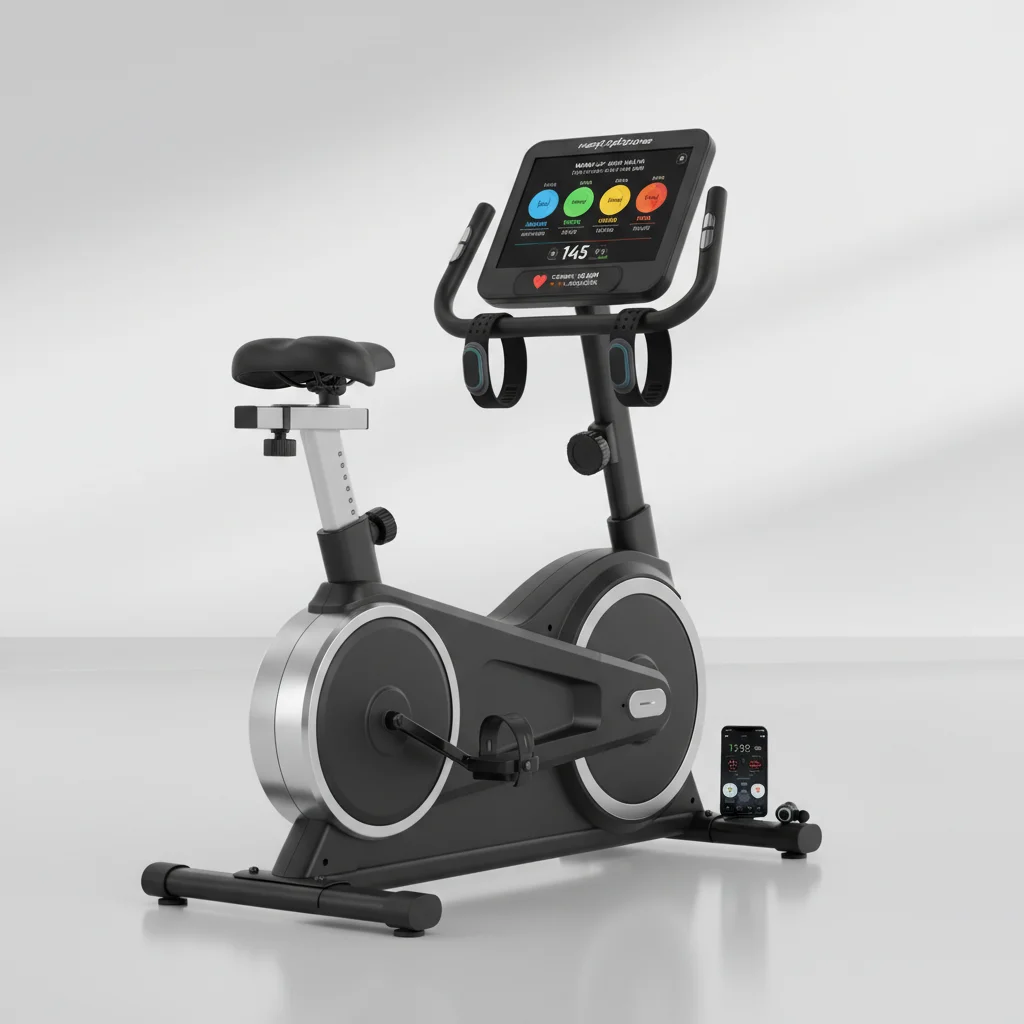
Understanding your exercise bike heart rate zones is crucial for maximizing the effectiveness of your cardio workouts. By training within specific heart rate zones, you can target different fitness goals, from fat burning to endurance building. There are typically five main heart rate zones, each corresponding to a percentage of your maximum heart rate, which we will explore in detail.
Calculating Your Maximum Heart Rate
Before you can determine your heart rate zones, you need to estimate your maximum heart rate (MHR). The most common and simplest method is to subtract your age from 220. For example, if you are 30 years old, your estimated MHR would be 190 beats per minute (bpm). While this is a general guideline, it provides a good starting point for most individuals. More precise measurements can be obtained through a fitness professional or a stress test.
Zone 1: Very Light (50-60% MHR)
The very light zone is ideal for warm-ups, cool-downs, and recovery sessions. In this zone, your breathing is easy, and you can comfortably hold a conversation. It’s excellent for improving overall health and preparing your body for more intense activity or aiding in muscle recovery after strenuous workouts. Spending time in this zone helps improve blood circulation and can reduce muscle soreness.
Zone 2: Light (60-70% MHR)
Often referred to as the ‘fat-burning zone,’ training in this light intensity helps your body become more efficient at using fat as fuel. While you burn fewer calories per minute compared to higher zones, a higher percentage of those calories come from fat. This zone is sustainable for longer durations, making it perfect for improving cardiovascular endurance and for those new to exercise. You should still be able to talk, but with some effort.
- Improves cardiovascular endurance
- Enhances fat metabolism
- Sustainable for longer workouts
- Good for beginners
- Aids in active recovery
Zone 3: Moderate (70-80% MHR)
|
Our Picks for the Best Exercise Bike in 2026
As an Amazon Associate I earn from qualifying purchases.
|
||
| Num | Product | Action |
|---|---|---|
| 1 | Exercise Bikes for Home,Indoor Cycling Bike with Adjustable Friction,Brake Pad Resistance Silent Belt Drive,330lbs Weight Capacity &Upgraded Version Seat for Home Cardio&Weight Loss |

|
| 2 | Exercise Bike for Home – 350LB Magnetic Resistance Indoor Cycling Bike, Silent Stationary Spin Bike with App Sync, Adjustable Seat, LCD Monitor, Smooth & Quiet for Cardio Workout |
|
| 3 | RELIFE REBUILD YOUR LIFE Exercise Bike Stationary for Home Indoor,Cycling Bike with Silent Belt Drive for Home Cardio,Brake Pad Resistance with djustable & Comfort Seat/PAD Holder/LCD Monitor. |
|
| 4 | Indoor Exercise Bike for Seniors, 5 IN 1 Foldable Stationary Bike with 16-Level Magnetic Resistance and Tri-Position Ride, 330LBS Capacity, 6.6 LBS Flywheel, for Home Workout 818 Gray |
|
| 5 | Exercise Bike, Wenoker Magnetic Stationary Bike for Home App Sync Indoor Bike with Adjustable Seat and Handlebar, Transport Wheels and Fitness Courses for Weight Loss |
|
| 6 | Exercise Bike, Adjustable Magnetic Resistance Stationary Bikes for Home Cardio with Exclusive App, Indoor Bike with 330lbs Weight Capacity Comfortable Seat, Tablet Mount and Fitness Courses |
|
| 7 | Exercise Bike, Magnetic Resistance Stationary Bikes for Home with App Compatible, Silent Indoor Cycling Bike with 350lbs Weight Capacity Comfortable Seat, Digital Monitor & Phone Mount |
|
| 8 | Exercise Bike, Wenoker Stationary Bike for Home, App Supported Indoor Bike with Silent Belt Drive, Heavy Flywheel, Multi-grips Handlebar and Upgraded Digital Display |
|
| 9 | Exercise Bikes for Home,Indoor Cycling Bike with Adjustable Magnetic,Brake Pad Resistance Silent Belt Drive,330lbs Weight Capacity &Upgraded Version Seat for Home Cardio&Weight Loss |
|
| 10 | MERACH Exercise Bike, Brake Pad Stationary Bike with Exclusive App, Low Noise Indoor Cycling Bike with 300lbs Weight Capacity, Tablet Mount and Fitness Courses for Weight Loss |
|
The moderate zone is where you start to build aerobic fitness. Your breathing becomes deeper and more rapid, and talking in full sentences becomes challenging. Training in this zone strengthens your heart and lungs, improving your overall stamina and fitness level. It’s a great zone for increasing your workout intensity without overtraining, and it’s often used in steady-state cardio sessions.
Zone 4: Hard (80-90% MHR)
This hard zone is where you significantly improve your anaerobic threshold. Your breathing will be heavy, and you’ll only be able to speak in short phrases. Workouts in this zone are intense and typically shorter in duration, such as interval training. They are highly effective for increasing speed, power, and overall athletic performance. However, due to the intensity, it’s important to incorporate adequate recovery.
For those looking to push their limits and see significant improvements in their fitness, incorporating Zone 4 training on a reliable exercise bike is key. Consider models that offer precise resistance control and heart rate monitoring for optimal results.
Zone 5: Maximum (90-100% MHR)
The maximum zone is for very short bursts of effort, often seen in high-intensity interval training (HIIT). You’ll be breathing extremely hard, and speaking will be impossible. This zone is not sustainable for long periods and should only be attempted by well-conditioned individuals. Training at this intensity can significantly improve your VO2 max, which is the maximum amount of oxygen your body can use during intense exercise. Always consult with a healthcare professional before engaging in maximum heart rate training.
To effectively monitor your heart rate zones, a good quality exercise bike with an integrated heart rate monitor or a compatible external device is essential. This allows you to stay within your target zones and make real-time adjustments to your intensity.

The information on calculating maximum heart rate was useful, but I wish there was a bit more detail on how to actually *stay* in a specific zone during a workout. Sometimes it feels like my heart rate jumps around a lot, even when I’m trying to maintain a steady pace on my bike. Maybe some tips on adjusting resistance or cadence to control it better would be good.
I’ve been using an exercise bike for a while but never really understood the science behind my workouts. Learning about the five main heart rate zones has been a game-changer. I used the 220 minus age formula to calculate my MHR and now I’m much more intentional about my rides, especially when I’m aiming for fat burning. My endurance has definitely improved since I started paying attention to these zones.
Finally, a clear breakdown of heart rate zones! I’ve always heard about them but never really understood what they meant for my exercise bike sessions. Now I know exactly why I should be aiming for Zone 2 on some days and Zone 4 on others. It’s really helped me diversify my routine and see better results.
This guide on heart rate zones is super helpful. I always just rode until I felt tired, but now I’m actually tracking my heart rate and trying to stay in Zone 3 for my endurance training. It’s made my workouts feel more productive. I appreciate the clear explanation of how each zone targets different goals.