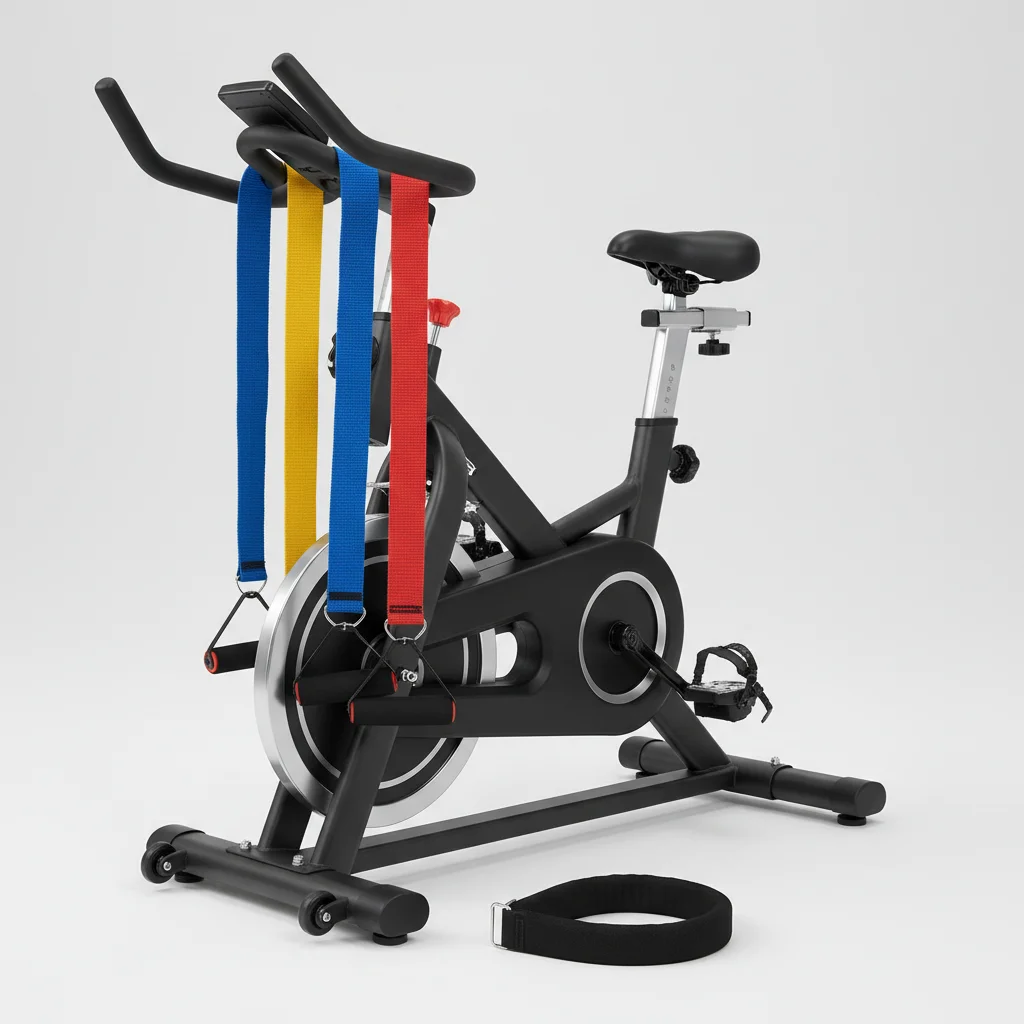
Exercise bike resistance bands can significantly enhance your workouts by adding upper body and core engagement, transforming a lower-body focused cardio session into a full-body exercise. This integration can lead to improved muscle tone, increased calorie expenditure, and a more dynamic fitness routine.
Understanding Resistance Bands on Exercise Bikes
Resistance bands are versatile fitness tools that provide external resistance to muscles. When integrated with an exercise bike, they allow users to perform upper body exercises simultaneously with their cycling. This dual-action approach targets muscle groups often neglected during traditional cycling, such as the biceps, triceps, shoulders, and back, while also engaging the core for stability.
The primary benefit lies in creating a more comprehensive workout. Instead of just focusing on leg strength and cardiovascular health, you can actively work your upper body, making your exercise time more efficient. This is particularly useful for individuals looking to maximize their workout in a limited timeframe or those aiming for a balanced physique.
Types of Resistance Bands and Their Application
There are several types of resistance bands, each suitable for different applications on an exercise bike. Loop bands are excellent for attaching to the handlebars or seat post for bicep curls, tricep extensions, or shoulder presses. Tube bands with handles offer a comfortable grip for pulling exercises, mimicking rowing motions or chest presses while pedaling. Flat bands can be used for a wider range of motion and can be secured in various ways to target specific muscles.
When selecting bands, consider the resistance level. Beginners should start with lighter bands and gradually progress to heavier ones as their strength improves. It’s also important to ensure the bands are durable and securely attached to the bike to prevent accidents during your workout.
Integrating Bands into Your Cycling Routine
|
Our Picks for the Best Exercise Bike in 2026
As an Amazon Associate I earn from qualifying purchases.
|
||
| Num | Product | Action |
|---|---|---|
| 1 | Exercise Bike, Magnetic Resistance Stationary Bikes for Home with App Compatible, Silent Indoor Cycling Bike with 350lbs Weight Capacity Comfortable Seat, Digital Monitor & Phone Mount |

|
| 2 | Exercise Bike, Wenoker Magnetic Stationary Bike for Home App Sync Indoor Bike with Adjustable Seat and Handlebar, Transport Wheels and Fitness Courses for Weight Loss |
|
| 3 | Indoor Exercise Bike for Seniors, 5 IN 1 Foldable Stationary Bike with 16-Level Magnetic Resistance and Tri-Position Ride, 330LBS Capacity, 6.6 LBS Flywheel, for Home Workout 818 Gray |
|
| 4 | Exercise Bike, Wenoker Stationary Bike for Home, App Supported Indoor Bike with Silent Belt Drive, Heavy Flywheel, Multi-grips Handlebar and Upgraded Digital Display |
|
| 5 | Exercise Bikes for Home,Indoor Cycling Bike with Adjustable Friction,Brake Pad Resistance Silent Belt Drive,330lbs Weight Capacity &Upgraded Version Seat for Home Cardio&Weight Loss |
|
| 6 | Exercise Bikes for Home,Indoor Cycling Bike with Adjustable Magnetic,Brake Pad Resistance Silent Belt Drive,330lbs Weight Capacity &Upgraded Version Seat for Home Cardio&Weight Loss |
|
| 7 | Exercise Bike, Adjustable Magnetic Resistance Stationary Bikes for Home Cardio with Exclusive App, Indoor Bike with 330lbs Weight Capacity Comfortable Seat, Tablet Mount and Fitness Courses |
|
| 8 | Exercise Bike for Home – 350LB Magnetic Resistance Indoor Cycling Bike, Silent Stationary Spin Bike with App Sync, Adjustable Seat, LCD Monitor, Smooth & Quiet for Cardio Workout |
|
| 9 | MERACH Exercise Bike, Brake Pad Stationary Bike with Exclusive App, Low Noise Indoor Cycling Bike with 300lbs Weight Capacity, Tablet Mount and Fitness Courses for Weight Loss |
|
| 10 | RELIFE REBUILD YOUR LIFE Exercise Bike Stationary for Home Indoor,Cycling Bike with Silent Belt Drive for Home Cardio,Brake Pad Resistance with djustable & Comfort Seat/PAD Holder/LCD Monitor. |
|
Incorporating resistance bands into your exercise bike routine is straightforward. You can perform various exercises while maintaining a steady pedaling pace. For example, during a moderate intensity ride, you can do sets of bicep curls, tricep kickbacks, or lateral raises. For core engagement, try twisting motions with a band held taut in front of you.
It’s advisable to start with shorter intervals of band work, perhaps 30-60 seconds per exercise, and gradually increase the duration as you build endurance and coordination. Remember to maintain proper form to avoid injury and maximize the effectiveness of each movement. A typical workout might involve 5-10 minutes of warm-up cycling, followed by 20-30 minutes of cycling with integrated band exercises, and a 5-minute cool-down.
Benefits Beyond Muscle Toning
Beyond muscle toning, using resistance bands with an exercise bike offers several other advantages. It can improve muscular endurance, as you’re performing resistance exercises for extended periods. The added upper body movement also increases overall calorie expenditure, contributing to more effective weight management. Furthermore, the dynamic nature of these workouts can prevent boredom and keep your fitness routine engaging.
- Increased calorie burn due to full-body engagement.
- Improved muscular endurance in both upper and lower body.
- Enhanced core stability through integrated movements.
- Greater workout variety, preventing plateaus and boredom.
- Convenient way to combine cardio and strength training.
Choosing the Right Exercise Bike for Band Integration
While most exercise bikes can accommodate resistance bands, some designs are more conducive to their use. Bikes with sturdy handlebars or accessible frame components provide better anchor points for bands. Recumbent bikes, with their back support, can be particularly good for upper body work as they allow for a more stable seated position. Upright bikes also work well, but ensure you maintain balance while performing exercises.
Ultimately, the effectiveness of exercise bike resistance bands depends on consistent and proper application. By adding this simple accessory, you can transform your cycling sessions into a more comprehensive and rewarding full-body workout.

I was skeptical about adding resistance bands to my spin bike, but wow, what a difference! I used to just focus on my legs, but now I can really feel my core and upper body working. It’s like a whole new workout and I’m definitely seeing better muscle tone in my arms. Highly recommend for anyone wanting to get more out of their cardio.
I’ve been looking for ways to make my exercise bike routine less monotonous, and these resistance bands are perfect. It’s amazing how much more engaged my shoulders and back feel. It truly transforms a regular ride into a more dynamic fitness routine. My workouts feel much more complete now.
I tried integrating resistance bands with my cycling as suggested, and while the idea of a full-body exercise is great, I found it a bit awkward to manage at first. The bands themselves are fine, but keeping my balance and form for upper body exercises while pedaling took some practice. I’m still using them, but it’s not as seamless as I hoped for increasing calorie expenditure.
These bands are a game-changer for making my home workouts more efficient. I love that I can target my biceps and triceps while still getting my cardio in. The dual-action approach mentioned really does make a difference. My only minor complaint is that it took a little getting used to coordinating everything, but it’s worth it.