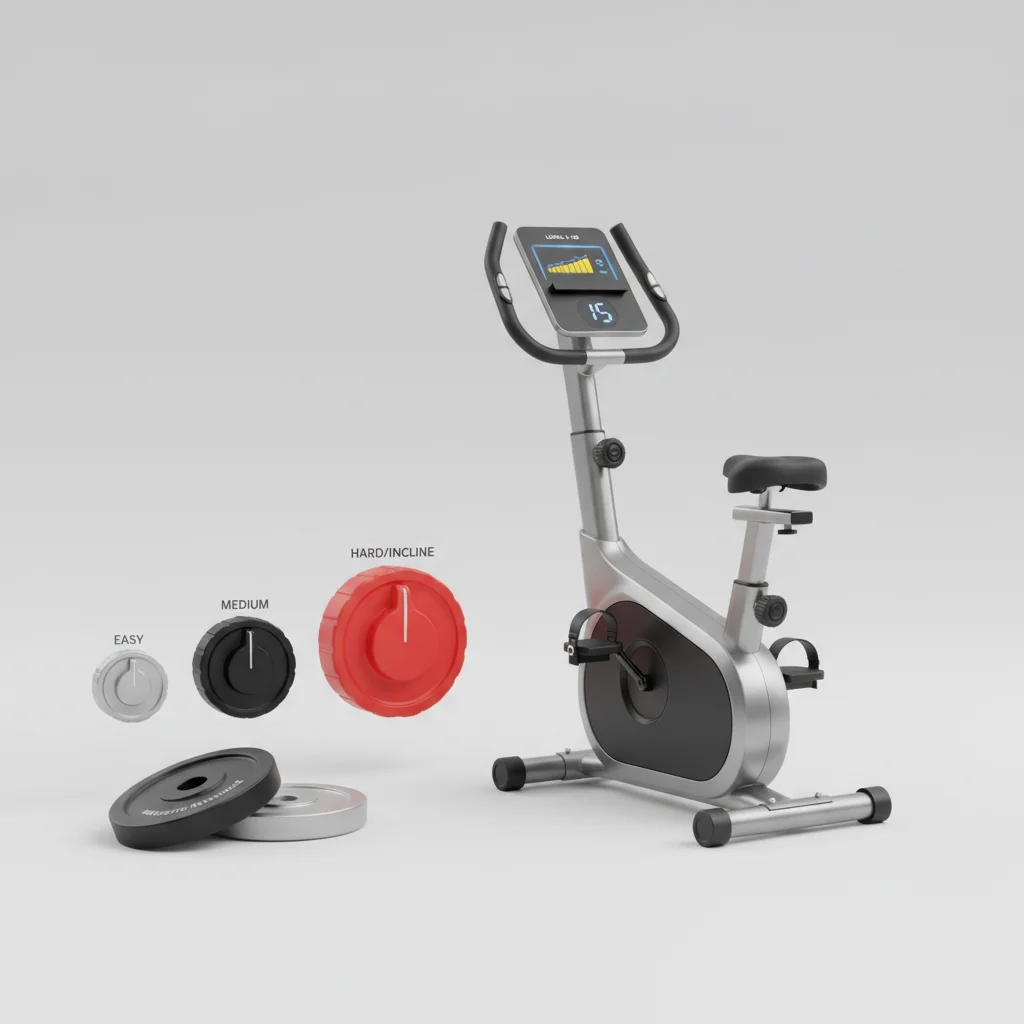
The ideal number of exercise bike resistance levels you need typically ranges from 8 to 24, depending on your fitness goals and the type of bike. For casual riders or beginners, 8-12 levels offer sufficient variation. More advanced users or those seeking intense interval training will benefit from bikes with 16 or more levels, providing finer adjustments for progressive overload.
Understanding Resistance Types and Their Impact
Exercise bikes primarily use three types of resistance: magnetic, air, and friction. Magnetic resistance, common in many home bikes, offers smooth, quiet operation and a wide range of levels, often controlled digitally. Air resistance bikes, frequently found in CrossFit gyms, provide a more dynamic workout where resistance increases with your pedaling speed. Friction resistance, typical of spin bikes, uses brake pads directly on the flywheel, offering a raw, direct feel but often with fewer distinct ‘levels’ and more manual adjustment. For browse all home exercise articles on this site.
Matching Resistance Levels to Your Fitness Goals
Your fitness objectives should dictate the number of resistance levels you prioritize. If your goal is general cardiovascular health and light exercise, a bike with 8-12 levels will be perfectly adequate for maintaining a consistent effort. For weight loss, a broader range of 12-16 levels allows for varied intensity workouts, including high-intensity interval training (HIIT) where quick changes in resistance are beneficial. Athletes or serious cyclists aiming for strength building and endurance will benefit most from bikes offering 16-24+ levels, enabling precise control over their training zones and progressive challenges.
- Beginner Fitness: 8-12 levels for gentle cardio and muscle engagement.
- Intermediate Training: 12-16 levels for varied workouts and moderate intensity.
- Advanced Performance: 16-24+ levels for precise control and high-intensity intervals.
- Rehabilitation: Fewer, very low resistance options for gentle movement.
- Cross-Training: Bikes with dynamic resistance (like air bikes) for full-body engagement.
The Role of Digital vs. Manual Resistance
|
Our Picks for the Best Exercise Bike in 2026
As an Amazon Associate I earn from qualifying purchases.
|
||
| Num | Product | Action |
|---|---|---|
| 1 | RELIFE REBUILD YOUR LIFE Exercise Bike Stationary for Home Indoor,Cycling Bike with Silent Belt Drive for Home Cardio,Brake Pad Resistance with djustable & Comfort Seat/PAD Holder/LCD Monitor. |

|
| 2 | Exercise Bikes for Home,Indoor Cycling Bike with Adjustable Magnetic,Brake Pad Resistance Silent Belt Drive,330lbs Weight Capacity &Upgraded Version Seat for Home Cardio&Weight Loss |
|
| 3 | Exercise Bike for Home – 350LB Magnetic Resistance Indoor Cycling Bike, Silent Stationary Spin Bike with App Sync, Adjustable Seat, LCD Monitor, Smooth & Quiet for Cardio Workout |
|
| 4 | Indoor Exercise Bike for Seniors, 5 IN 1 Foldable Stationary Bike with 16-Level Magnetic Resistance and Tri-Position Ride, 330LBS Capacity, 6.6 LBS Flywheel, for Home Workout 818 Gray |
|
| 5 | Exercise Bike, Wenoker Magnetic Stationary Bike for Home App Sync Indoor Bike with Adjustable Seat and Handlebar, Transport Wheels and Fitness Courses for Weight Loss |
|
| 6 | Exercise Bike, Magnetic Resistance Stationary Bikes for Home with App Compatible, Silent Indoor Cycling Bike with 350lbs Weight Capacity Comfortable Seat, Digital Monitor & Phone Mount |
|
| 7 | Exercise Bikes for Home,Indoor Cycling Bike with Adjustable Friction,Brake Pad Resistance Silent Belt Drive,330lbs Weight Capacity &Upgraded Version Seat for Home Cardio&Weight Loss |
|
| 8 | Exercise Bike, Wenoker Stationary Bike for Home, App Supported Indoor Bike with Silent Belt Drive, Heavy Flywheel, Multi-grips Handlebar and Upgraded Digital Display |
|
| 9 | MERACH Exercise Bike, Brake Pad Stationary Bike with Exclusive App, Low Noise Indoor Cycling Bike with 300lbs Weight Capacity, Tablet Mount and Fitness Courses for Weight Loss |
|
| 10 | Exercise Bike, Adjustable Magnetic Resistance Stationary Bikes for Home Cardio with Exclusive App, Indoor Bike with 330lbs Weight Capacity Comfortable Seat, Tablet Mount and Fitness Courses |
|
Modern exercise bikes often feature digital resistance control, allowing for seamless transitions between levels, sometimes even automatically adjusting during programmed workouts. This is particularly useful for structured training plans and virtual rides. Manual resistance, typically found on more budget-friendly or older models, requires physical adjustment via a knob or lever. While effective, it can interrupt the flow of a workout. Consider your preference for convenience and integration with fitness apps when choosing between these systems.
Why More Resistance Levels Aren’t Always Better
While a higher number of resistance levels might seem superior, it’s the quality and consistency of those levels that truly matter. A bike with 10 well-calibrated, distinct levels can provide a more effective workout than a bike with 20 poorly differentiated levels. Look for bikes where each increment feels noticeably different and provides a smooth transition. Also, consider the maximum resistance; ensure it’s challenging enough for your peak performance. Don’t get caught up in marketing numbers alone; read reviews and test if possible to gauge the actual feel of the resistance.
Maintaining Your Bike’s Resistance System
Proper maintenance ensures your exercise bike’s resistance system remains accurate and effective. For magnetic bikes, this often involves keeping the internal components clean and free of dust, as well as checking for any loose connections if it’s digitally controlled. Friction bikes require regular inspection and potential replacement of brake pads, and ensuring the flywheel is clean. Air bikes benefit from keeping the fan clear of obstructions. Following the manufacturer’s maintenance guidelines will prolong the life and accuracy of your bike’s resistance mechanism, ensuring consistent workout quality.
