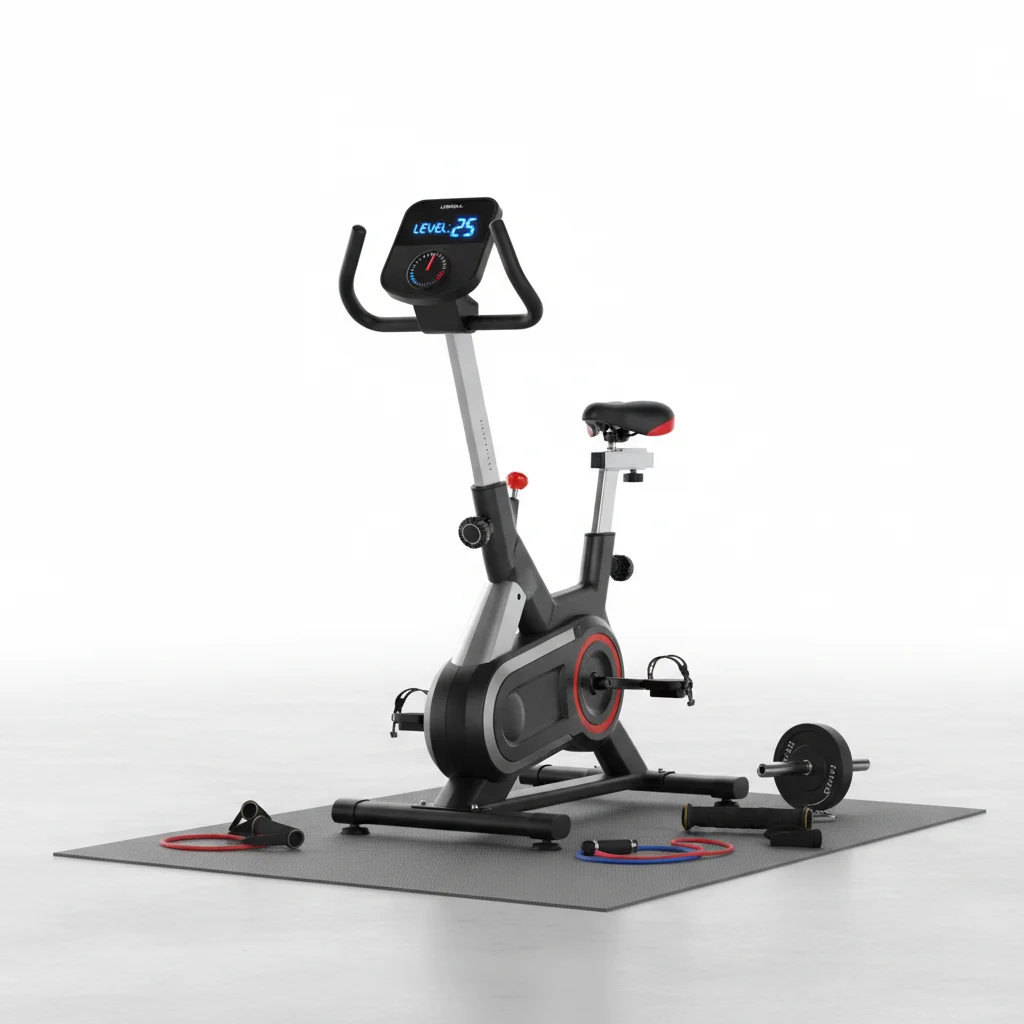
The ideal number of exercise bike resistance levels you need depends entirely on your fitness goals and current conditioning. For most casual users and beginners, a bike with 8 to 12 resistance levels offers sufficient versatility to progress from light cardio to more challenging workouts. Advanced riders or those seeking intense interval training may benefit from bikes offering 16 or more levels for finer control over their intensity.
Understanding Resistance Mechanisms
Exercise bikes primarily use three types of resistance: magnetic, friction, and air. Magnetic resistance, found in many modern bikes, uses magnets to create a smooth, quiet, and consistent challenge. These often provide a wide range of distinct levels. Friction resistance, common in spin bikes, uses a pad that presses against the flywheel, offering a more direct and often infinite adjustment, though it can be noisier and require more maintenance. Air resistance bikes use a fan, where the resistance increases with the speed of pedaling, providing a dynamic workout that naturally scales with your effort. For best home exercise roundups on this site.
Matching Resistance to Your Fitness Goals
If your goal is general fitness and light cardio, a bike with 8-10 magnetic resistance levels will likely suffice. This range allows for comfortable warm-ups, steady-state cardio, and a few steps up in intensity. For weight loss, you’ll want a bike that allows for both sustained moderate effort and bursts of higher intensity, making 12-16 levels a good target. Athletes or serious cyclists training for endurance or power will benefit most from bikes offering 16+ levels or the infinite adjustment of a friction-based spin bike, enabling precise control over their training zones.
The Importance of Smooth Transitions
|
Our Picks for the Best Exercise Bike in 2026
As an Amazon Associate I earn from qualifying purchases.
|
||
| Num | Product | Action |
|---|---|---|
| 1 | Exercise Bike, Wenoker Stationary Bike for Home, App Supported Indoor Bike with Silent Belt Drive, Heavy Flywheel, Multi-grips Handlebar and Upgraded Digital Display |

|
| 2 | MERACH Exercise Bike, Brake Pad Stationary Bike with Exclusive App, Low Noise Indoor Cycling Bike with 300lbs Weight Capacity, Tablet Mount and Fitness Courses for Weight Loss |
|
| 3 | Exercise Bike for Home – 350LB Magnetic Resistance Indoor Cycling Bike, Silent Stationary Spin Bike with App Sync, Adjustable Seat, LCD Monitor, Smooth & Quiet for Cardio Workout |
|
| 4 | Exercise Bikes for Home,Indoor Cycling Bike with Adjustable Friction,Brake Pad Resistance Silent Belt Drive,330lbs Weight Capacity &Upgraded Version Seat for Home Cardio&Weight Loss |
|
| 5 | Indoor Exercise Bike for Seniors, 5 IN 1 Foldable Stationary Bike with 16-Level Magnetic Resistance and Tri-Position Ride, 330LBS Capacity, 6.6 LBS Flywheel, for Home Workout 818 Gray |
|
| 6 | Exercise Bike, Adjustable Magnetic Resistance Stationary Bikes for Home Cardio with Exclusive App, Indoor Bike with 330lbs Weight Capacity Comfortable Seat, Tablet Mount and Fitness Courses |
|
| 7 | Exercise Bikes for Home,Indoor Cycling Bike with Adjustable Magnetic,Brake Pad Resistance Silent Belt Drive,330lbs Weight Capacity &Upgraded Version Seat for Home Cardio&Weight Loss |
|
| 8 | Exercise Bike, Wenoker Magnetic Stationary Bike for Home App Sync Indoor Bike with Adjustable Seat and Handlebar, Transport Wheels and Fitness Courses for Weight Loss |
|
| 9 | Exercise Bike, Magnetic Resistance Stationary Bikes for Home with App Compatible, Silent Indoor Cycling Bike with 350lbs Weight Capacity Comfortable Seat, Digital Monitor & Phone Mount |
|
| 10 | RELIFE REBUILD YOUR LIFE Exercise Bike Stationary for Home Indoor,Cycling Bike with Silent Belt Drive for Home Cardio,Brake Pad Resistance with djustable & Comfort Seat/PAD Holder/LCD Monitor. |
|
Beyond the sheer number of resistance levels, the smoothness of the transitions between them is crucial. A bike with many levels but jerky, inconsistent changes can disrupt your workout flow and make it difficult to maintain a steady pace or accurately follow a training program. High-quality bikes, especially those with magnetic resistance, typically offer seamless transitions, allowing you to increase or decrease intensity without jarring interruptions. Always consider the feel of the resistance change when evaluating a bike.
When More Resistance Levels Are Better
More resistance levels are generally better for advanced users, those with specific training programs, or households with multiple users of varying fitness levels. A wider range allows for more granular control over your workout intensity, which is particularly beneficial for interval training, hill simulations, and progressive overload. It also ensures that as your fitness improves, you won’t quickly outgrow the bike’s capabilities. For example, a bike with 20+ levels can provide a very light warm-up and an extremely challenging climb, catering to a broad spectrum of needs.
- Beginners: 8-10 levels for foundational fitness.
- Intermediate Users: 12-16 levels for varied workouts and progression.
- Advanced Users: 16+ levels or infinite friction for precise training.
- Multiple Users: A wider range accommodates different fitness levels.
- Specific Training: More levels allow for detailed interval and strength work.
Considering Smart Bikes and Digital Resistance
Many modern exercise bikes, particularly smart bikes, integrate digital resistance control. While they might advertise a specific number of physical levels, the digital interface often allows for even finer adjustments, sometimes simulating hundreds of micro-levels. These bikes can automatically adjust resistance based on guided workouts, virtual routes, or heart rate zones, providing a highly personalized and engaging experience. When evaluating these, consider the overall ecosystem and the quality of the software, not just the raw number of physical resistance settings.These advanced features can significantly enhance your training effectiveness and enjoyment, making your workouts more dynamic and responsive to your real-time performance.

I’ve been using my magnetic resistance bike for a few months now and it’s been fantastic. The quiet operation is a huge plus, especially since I often work out early in the morning while others are still asleep. I found that the 10 levels of resistance on my model are perfect for my needs, allowing me to switch between a steady pace and more intense bursts without any jarring transitions. Definitely recommend looking for magnetic if noise is a concern.
My friction resistance bike gets the job done, but I do wish it was a bit quieter. It’s not terrible, but you definitely notice the sound when you’re really pushing it. I like the direct feel of the resistance, and it’s easy to adjust, but I’m starting to think I should have invested in a magnetic one for a smoother experience. For the price though, it’s hard to complain too much.
As a beginner, I was a bit overwhelmed by all the options, but I focused on finding a bike with at least 8-12 resistance levels as suggested. My bike has 9, and it’s been perfect for me to gradually increase my intensity. I’m already feeling stronger and can handle higher levels than when I started. It’s great to have that room to grow without needing a new machine.
I’m an intermediate rider and was debating between a bike with 12 or 16 resistance levels. I ended up going with one that has 14, and it’s been a good balance. I can definitely feel the difference between each level, which helps a lot with my interval training. For anyone serious about progressing, having more than just a few levels really makes a difference in tailoring your workouts.