Assembling an exercise bike at home typically takes between 30 minutes to 2 hours, depending on the model’s complexity and your experience. Proper assembly is crucial for ensuring the bike’s long-term functionality, stability, and preventing potential injuries, as an unstable machine can lead to reduced lifespan and an unsafe workout environment. This guide outlines the essential steps for a secure setup, allowing you to focus on your fitness goals with peace of mind.
Preparing for Assembly: Your First Steps to Success
Before you even open the box, a little preparation goes a long way in ensuring a smooth and safe exercise bike assembly. Taking these initial steps seriously can save you time, frustration, and potential re-work later.
First, choose the right spot for your new fitness equipment. Look for a location with ample space, a flat surface, and good ventilation. It’s crucial to assemble the bike in its final intended location to avoid the hassle of moving a heavy, fully assembled machine through doorways or tight spaces. Ensure the floor is level to prevent wobbling, which can be a significant safety hazard.
Next, gather your tools and equipment. Your exercise bike will likely come with basic assembly tools, but it’s always beneficial to have your own set of wrenches and screwdrivers on hand. Consult your bike’s assembly manual for a specific list of required tools. Having the correct tools readily available ensures proper tightening and prevents damage to parts.
Finally, unbox and organize all components. Carefully unpack the bike and lay out all parts. Group similar components together and cross-reference them with the parts list in your manual to confirm everything is present and accounted for. This organizational step helps prevent overlooking crucial pieces and makes the assembly process more intuitive.
 A person carefully unboxing and organizing exercise bike parts on a protective mat on a flat floor, with various tools laid out nearby. The scene is bright and organized, showing preparedness.
Step-by-Step Guide to Assembling Your Exercise Bike
While specific steps can vary slightly between models and manufacturers, most exercise bikes follow a general assembly sequence. Always refer to your bike’s specific instruction manual, as it provides the most accurate and detailed guidance for your particular model.
Begin by attaching the stabilizer bars. These are usually located at the front and rear base of the bike and are vital for its stability. The front stabilizer often includes transport wheels. Carefully align the holes on the stabilizer bars with the frame and secure them with the provided bolts and washers, initially hand-tightening, then using your wrench. Ensure the wheels on the front stabilizer are pointing up so they face forward when the bike is upright.
Next, install the seat post and seat. Slide the seat post into the designated opening on the main frame. Attach the seat to the top of the seat post using the hardware provided. Make sure it’s facing the correct direction and is securely fastened. Adjustable mechanisms will be tightened later for ergonomic fit.
Following this, mount the handlebars. The handlebars typically attach to a vertical post at the front of the bike. Guide any console wiring through the handlebar post if required, then secure the handlebars to the frame using bolts and washers. Ensure they are aligned straight and tight enough to prevent movement during use.
After the handlebars, connect the console and wiring. Many modern exercise bikes feature an electronic console. Carefully connect any electrical wires or cables as instructed in your manual, ensuring they are not pinched. Then, attach the console to its bracket on the handlebar post. Double-check that all connections are snug and secure to avoid electrical issues.
Finally, attach the pedals. This step is crucial and often overlooked for its specific detail. The right pedal (marked ‘R’) threads clockwise to tighten, while the left pedal (marked ‘L’) threads counter-clockwise to tighten. This is vital to prevent the pedals from unscrewing during use. Turn them by hand first to ensure the threads align, then use a wrench to tighten them securely.
Crucial Safety Checks After Assembly
Once all the parts of your exercise bike are in place, the assembly process isn’t truly complete until you’ve performed thorough safety checks. These steps are paramount to guaranteeing your bike is ready for a safe and effective workout session.
First, verify the bike’s stability. Give the bike a gentle push and pull from different directions to check for any wobbling or instability. If you notice any movement, check that all bolts are secure and use the bike’s leveling feet (if available) to even it out on your floor. An unstable bike can easily tip or shift during a workout, leading to falls.
Next, tighten all connections. Go back over every bolt, screw, and connection point you assembled and ensure they are all securely tightened. Be careful not to over-tighten, as this can strip threads or crack plastic components, but also avoid under-tightening, which leads to loose, rattling parts and potential equipment collapse. A firm, snug fit is what you’re aiming for.
After confirming structural integrity, test the functionality of all moving parts. Spin the pedals to ensure they move smoothly without resistance or grinding. Test the resistance mechanism, if applicable, to confirm it adjusts correctly. If your bike has a brake, test its responsiveness. This ensures all mechanical elements are working as intended.
Finally, adjust the bike for your body. This ergonomic setup is essential for comfort, performance, and injury prevention. Adjust the seat height so that when one pedal is at its lowest point (6 o’clock), your leg has a slight, noticeable bend in the knee (about 5-10 degrees). The seat should generally be level with your hipbone when standing beside the bike. For handlebar height, sit upright, extend your arms forward parallel to the ground, then hinge slightly from your hips; the handlebars should be at a height that allows you to maintain a neutral spine with slightly bent elbows, avoiding overreaching or hunching.
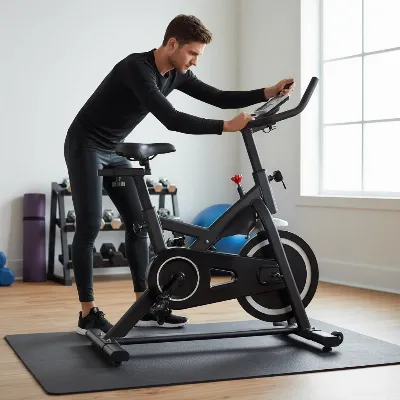 A person checking the stability of a newly assembled exercise bike by gently pushing and pulling it, ensuring all parts are secure and the bike is level on the floor. The setting is a home gym.
Tips for a Smooth and Safe Assembly Process
Assembling an exercise bike can be straightforward, but keeping a few key tips in mind can make the process even smoother and safer. These insights can help you avoid common pitfalls and ensure a successful setup.
The most crucial advice is to read the manual thoroughly. It may seem tedious, but every exercise bike model has unique aspects. Your manufacturer’s instructions are tailored specifically for your equipment, detailing the correct order of steps, torque specifications, and any special considerations. Do not skip any steps, as this can compromise the bike’s integrity and safety.
Furthermore, avoid common mistakes that many first-time assemblers make. These include using the wrong tools, which can strip bolts or damage components, or rushing through the process. Take your time, and if something doesn’t feel right, stop and consult the manual. Ignoring floor leveling, as mentioned earlier, is another frequent error that leads to an unstable ride.
Should you encounter any issues, these troubleshooting quick fixes. If parts are missing or damaged, immediately contact the manufacturer for replacements; attempting to substitute parts can be dangerous. If you have difficulty aligning holes, try loosening nearby bolts slightly to create some wiggle room, then re-tighten once everything is aligned. If the bike feels unstable after assembly, systematically re-check the tightness of all bolts and adjust the leveling feet as needed.
“A well-assembled exercise bike is the foundation of a great workout. Don’t underestimate the importance of taking your time and following every step carefully; it directly impacts your safety and the longevity of your equipment.” – Dr. Emily Chen, Sports Physiologist
Conclusion
Successfully assembling your new exercise bike at home is more than just a task; it’s a vital step in preparing for a safe, effective, and enjoyable fitness journey. By meticulously preparing your space, following the assembly instructions, and performing thorough post-assembly safety checks, you ensure that your exercise bike is stable, functional, and perfectly adjusted for your body. patience and attention to detail are your best allies in this process. With your exercise bike expertly set up, you are now ready to embark on invigorating workouts that support your health and well-being. What fitness milestones will you achieve with your safely assembled exercise bike?
Frequently Asked Questions
How long does it typically take to assemble an exercise bike?
|
Our Picks for the Best Exercise Bike in 2026
As an Amazon Associate I earn from qualifying purchases.
|
||
| Num | Product | Action |
|---|---|---|
| 1 | Exercise Bikes for Home,Indoor Cycling Bike with Adjustable Magnetic,Brake Pad Resistance Silent Belt Drive,330lbs Weight Capacity &Upgraded Version Seat for Home Cardio&Weight Loss |

|
| 2 | Exercise Bike, Magnetic Resistance Stationary Bikes for Home with App Compatible, Silent Indoor Cycling Bike with 350lbs Weight Capacity Comfortable Seat, Digital Monitor & Phone Mount |
|
| 3 | Exercise Bike, Adjustable Magnetic Resistance Stationary Bikes for Home Cardio with Exclusive App, Indoor Bike with 330lbs Weight Capacity Comfortable Seat, Tablet Mount and Fitness Courses |
|
| 4 | Exercise Bikes for Home,Indoor Cycling Bike with Adjustable Friction,Brake Pad Resistance Silent Belt Drive,330lbs Weight Capacity &Upgraded Version Seat for Home Cardio&Weight Loss |
|
| 5 | Exercise Bike, Wenoker Magnetic Stationary Bike for Home App Sync Indoor Bike with Adjustable Seat and Handlebar, Transport Wheels and Fitness Courses for Weight Loss |
|
| 6 | Indoor Exercise Bike for Seniors, 5 IN 1 Foldable Stationary Bike with 16-Level Magnetic Resistance and Tri-Position Ride, 330LBS Capacity, 6.6 LBS Flywheel, for Home Workout 818 Gray |
|
| 7 | MERACH Exercise Bike, Brake Pad Stationary Bike with Exclusive App, Low Noise Indoor Cycling Bike with 300lbs Weight Capacity, Tablet Mount and Fitness Courses for Weight Loss |
|
| 8 | Exercise Bike for Home – 350LB Magnetic Resistance Indoor Cycling Bike, Silent Stationary Spin Bike with App Sync, Adjustable Seat, LCD Monitor, Smooth & Quiet for Cardio Workout |
|
| 9 | RELIFE REBUILD YOUR LIFE Exercise Bike Stationary for Home Indoor,Cycling Bike with Silent Belt Drive for Home Cardio,Brake Pad Resistance with djustable & Comfort Seat/PAD Holder/LCD Monitor. |
|
| 10 | Exercise Bike, Wenoker Stationary Bike for Home, App Supported Indoor Bike with Silent Belt Drive, Heavy Flywheel, Multi-grips Handlebar and Upgraded Digital Display |
|
Assembly time varies depending on the bike’s complexity and your experience level, but most exercise bikes can be assembled within 30 minutes to 2 hours. Following the manual step-by-step and having all tools ready will streamline the process.
What tools do I need for exercise bike assembly?
Most exercise bikes come with basic assembly tools, such as multi-wrenches and Allen keys. However, having your own adjustable wrench, screwdriver set, and perhaps a socket wrench can make the process easier and ensure better tightening.
What should I do if parts are missing or damaged?
If you discover any missing or damaged parts, do not attempt to proceed with assembly. Immediately stop and contact the manufacturer or retailer where you purchased the exercise bike. They will arrange for replacement parts.
How do I ensure my assembled exercise bike is stable?
After assembly, test the bike by gently rocking it to check for wobbles. Ensure all bolts are securely tightened, and adjust any leveling feet on the base of the bike to compensate for uneven floor surfaces until the bike is perfectly stable.
Why are pedal directions important during assembly?
Pedals are threaded differently: the right pedal tightens clockwise, and the left pedal tightens counter-clockwise. This design prevents them from loosening while you pedal. Incorrectly attaching them can cause them to come unscrewed during use, posing a safety risk.
Frequently Asked Questions
How long does it typically take to assemble an exercise bike?
Most exercise bikes can be assembled within 30 minutes to 2 hours. The exact time depends on the bike's complexity and your familiarity with assembly tasks. Having all necessary tools prepared and following the manual step-by-step will help streamline the process.
What tools are essential for exercise bike assembly?
While many exercise bikes include basic assembly tools like multi-wrenches and Allen keys, it's beneficial to have your own adjustable wrench, a full screwdriver set, and potentially a socket wrench. These additional tools can facilitate easier and more secure tightening of components.
What should I do if I find missing or damaged parts during assembly?
If you discover any missing or damaged parts, immediately stop the assembly process. Do not attempt to substitute parts or proceed. Contact the manufacturer or the retailer where you purchased the exercise bike to arrange for replacement parts, ensuring safety and proper functionality.
How can I ensure my assembled exercise bike is stable and safe?
After assembly, gently rock the bike from different directions to check for any wobbling. Confirm that all bolts are securely tightened, and utilize any leveling feet on the bike's base to adjust for uneven floor surfaces. A stable bike prevents tipping and ensures a safe workout.
Why is the direction of pedal threading important during installation?
Pedals have specific threading directions: the right pedal tightens clockwise, and the left pedal tightens counter-clockwise. This design is critical to prevent the pedals from unscrewing themselves during use, which could pose a significant safety risk. Always ensure correct threading for secure attachment.
How to Safely Assemble Your Exercise Bike
This guide provides a step-by-step process for safely assembling your exercise bike at home, ensuring stability and proper functionality for a secure workout.
Choose a flat, well-ventilated area for assembly and ensure it's the bike's final location. Gather all tools, including those provided and any personal wrenches or screwdrivers. Unbox and organize all bike components, cross-referencing with the manual's parts list.
Begin by securing the front and rear stabilizer bars to the bike's base with bolts and washers, hand-tightening first, then using a wrench. Next, slide the seat post into the frame and attach the seat, ensuring it's facing the correct direction and securely fastened.
Attach the handlebars to the vertical post at the front of the bike, guiding any console wiring through if necessary, and secure them tightly. Carefully connect all electrical wires for the console, ensuring they are not pinched, then mount the console to its bracket.
This is a critical step. The right pedal (marked 'R') threads clockwise to tighten, while the left pedal (marked 'L') threads counter-clockwise. Hand-thread them first to align, then use a wrench to tighten securely, preventing them from unscrewing during use.
After assembly, verify the bike's stability by gently rocking it and tightening all connections. Test all moving parts, including pedals and resistance. Finally, adjust the seat height and handlebar position for your body, ensuring a slight knee bend at the pedal's lowest point and a neutral spine.

I just got a new Peloton, and while it’s a bit different, the core principles here for a secure setup were spot on. I made sure to double-check every connection point, especially after reading about preventing potential injuries from an unstable machine. It’s great to have that peace of mind during my workouts.
I was dreading putting together my new stationary bike, but following these steps made it so much easier. The tip about choosing a flat surface beforehand was a lifesaver; I almost started in a spot that would have been wobbly. It took me about an hour and a half, which was right in the middle of the estimated time. Feeling much safer on it now!
This guide was really helpful for assembling my new bike. I appreciated the emphasis on checking all the bolts and connections; I found one that was a little loose after my initial pass. It definitely made me feel more confident about the stability. My only minor complaint is that I wish there was a bit more detail on attaching the pedals, but overall, a solid resource.
The advice on preparing for assembly was good, especially about having enough space. However, I still struggled a bit with the more complex parts of my bike, even with the general steps. It took me closer to two hours, and I had to re-do a couple of things. I think some models just have too many small pieces, no matter how well you prepare.