Choosing the right exercise bike can improve your home workout routine, offering a convenient and effective way to boost your health. With so many options available, understanding what truly sets a great bike apart is crucial. This comprehensive guide dives into the world of magnetic resistance exercise bikes, highlighting their unparalleled benefits, essential features, and top models for 2026, helping you find the perfect partner for your fitness journey. We’ll explore why these bikes are a superior choice for a smooth, quiet, and highly effective workout, guiding you through every step from selection to maintenance.
Exercise Bikes: A Comprehensive Guide to Magnetic Resistance Models
Exercise bikes are a cornerstone of home fitness, providing an accessible and impactful way to improve cardiovascular health, manage weight, and strengthen muscles. Among the various types, those featuring magnetic resistance stand out for their advanced technology and superior user experience, making them a favored category for fitness enthusiasts of all levels.
The Remarkable Benefits of Magnetic Resistance Exercise Bikes
Magnetic resistance exercise bikes have gained immense popularity, and for good reason. They offer a compelling blend of performance, comfort, and longevity that traditional resistance systems often can’t match.
At their core, these bikes utilize magnets to create tension against a flywheel without any physical contact, leading to a remarkably smooth and quiet operation. This absence of friction means you can enjoy your workout without disturbing others, perfect for early morning sessions or late-night rides in shared living spaces. Beyond the quiet ride, the magnetic system allows for precise and fluid adjustments of resistance levels, enabling seamless transitions that cater to a wide spectrum of fitness goals, from gentle recovery rides to intense interval training.
The health benefits of regular cycling on these machines are extensive. They provide a low-impact cardiovascular workout, protecting your joints while effectively improving heart health, increasing stamina, and aiding in weight management. Engaging your lower body, magnetic resistance bikes also contribute to muscle toning in the legs and glutes.
These bikes are incredibly versatile and suitable for a diverse group of individuals. They are an excellent choice for beginners starting a fitness routine, older adults seeking safe exercise, and individuals recovering from injuries due to their low-impact nature. Even seasoned athletes can benefit from the customizable and challenging workouts these bikes offer. The minimal maintenance required, thanks to fewer moving parts and reduced wear and tear, further enhances their appeal as a long-term investment.
Understanding Different Types of Exercise Bikes and Magnetic Resistance
|
Our Picks for the Best Exercise Bike in 2026
As an Amazon Associate I earn from qualifying purchases.
|
||
| Num | Product | Action |
|---|---|---|
| 1 | RELIFE REBUILD YOUR LIFE Exercise Bike Stationary for Home Indoor,Cycling Bike with Silent Belt Drive for Home Cardio,Brake Pad Resistance with djustable & Comfort Seat/PAD Holder/LCD Monitor. |

|
| 2 | MERACH Exercise Bike, Brake Pad Stationary Bike with Exclusive App, Low Noise Indoor Cycling Bike with 300lbs Weight Capacity, Tablet Mount and Fitness Courses for Weight Loss |
|
| 3 | Exercise Bike, Adjustable Magnetic Resistance Stationary Bikes for Home Cardio with Exclusive App, Indoor Bike with 330lbs Weight Capacity Comfortable Seat, Tablet Mount and Fitness Courses |
|
| 4 | Exercise Bike for Home – 350LB Magnetic Resistance Indoor Cycling Bike, Silent Stationary Spin Bike with App Sync, Adjustable Seat, LCD Monitor, Smooth & Quiet for Cardio Workout |
|
| 5 | Indoor Exercise Bike for Seniors, 5 IN 1 Foldable Stationary Bike with 16-Level Magnetic Resistance and Tri-Position Ride, 330LBS Capacity, 6.6 LBS Flywheel, for Home Workout 818 Gray |
|
| 6 | Exercise Bike, Magnetic Resistance Stationary Bikes for Home with App Compatible, Silent Indoor Cycling Bike with 350lbs Weight Capacity Comfortable Seat, Digital Monitor & Phone Mount |
|
| 7 | Exercise Bike, Wenoker Magnetic Stationary Bike for Home App Sync Indoor Bike with Adjustable Seat and Handlebar, Transport Wheels and Fitness Courses for Weight Loss |
|
| 8 | Exercise Bikes for Home,Indoor Cycling Bike with Adjustable Magnetic,Brake Pad Resistance Silent Belt Drive,330lbs Weight Capacity &Upgraded Version Seat for Home Cardio&Weight Loss |
|
| 9 | Exercise Bike, Wenoker Stationary Bike for Home, App Supported Indoor Bike with Silent Belt Drive, Heavy Flywheel, Multi-grips Handlebar and Upgraded Digital Display |
|
| 10 | Exercise Bikes for Home,Indoor Cycling Bike with Adjustable Friction,Brake Pad Resistance Silent Belt Drive,330lbs Weight Capacity &Upgraded Version Seat for Home Cardio&Weight Loss |
|
Exercise bikes come in various forms, each designed to meet different preferences and fitness objectives. Magnetic resistance technology is integrated into several popular styles, enhancing their performance and user experience.
- Upright Exercise Bikes: These bikes mimic the riding posture of a traditional outdoor bicycle, placing the rider in an upright position. They are generally compact and suitable for those looking for a straightforward cardio workout. When equipped with magnetic resistance, upright bikes offer quiet operation and smooth changes in intensity, making them excellent for apartment living or dedicated home gyms.
- Recumbent Exercise Bikes: Characterized by a reclined seating position with a backrest and pedals positioned in front of the body, recumbent bikes prioritize comfort and back support. They are ideal for individuals with lower back pain, joint issues, or those who prefer a more relaxed workout. Magnetic resistance on recumbent bikes ensures a quiet and consistent ride, allowing users to focus on their workout without discomfort.
- Spin Bikes (Indoor Cycle Bikes): Designed to simulate the experience of outdoor road cycling, spin bikes feature a heavier flywheel and an aggressive riding posture. They are favored for high-intensity interval training (HIIT) and immersive studio-style workouts. Magnetic resistance in spin bikes is particularly beneficial, providing instant, smooth resistance changes crucial for dynamic cycling classes, while keeping noise levels down.
Comparison of Resistance Systems:
Understanding how magnetic resistance stacks up against other types is key to appreciating its advantages.
- Magnetic Resistance: As discussed, this system uses magnets to create resistance against the flywheel without physical contact. This results in a virtually silent operation, smooth resistance transitions, minimal maintenance, and enhanced durability due to reduced wear and tear. It often comes with electronic controls, offering precise, preset resistance levels and compatibility with smart fitness apps.
- Friction Resistance: These bikes use a felt or leather pad that applies direct pressure to the flywheel to create resistance. While generally more affordable upfront and capable of providing very high resistance, they tend to be noisier due to the constant contact and friction. They also require more maintenance, as the brake pads wear out and need regular replacement, which can add to long-term costs.
- Air Resistance: Air bikes feature a large fan as their resistance mechanism. The faster you pedal, the more air the fan displaces, creating greater resistance. This “variable resistance” system is excellent for high-intensity workouts and full-body engagement (many have moving handlebars) but is typically the loudest of the three due to the spinning fan. Air bikes also lack manual resistance adjustments; resistance is solely determined by pedaling speed.
For those prioritizing a quiet, smooth, and low-maintenance workout with precise control, magnetic resistance bikes are generally the superior choice, especially for home use where noise and upkeep are significant considerations.
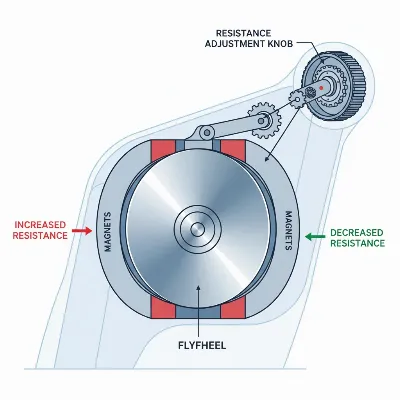 Diagram illustrating how magnetic resistance works in an exercise bike
Key Features to Consider When Buying a Magnetic Resistance Exercise Bike
When investing in a magnetic resistance exercise bike, several features can significantly impact your workout experience and the overall value of your purchase. Paying attention to these details will ensure you select a model that perfectly aligns with your fitness goals and lifestyle.
- Display and Console Connectivity: A clear and informative display is crucial for tracking your progress. Look for consoles that show essential metrics such as speed, distance, time, calories burned, and heart rate. Many modern magnetic bikes also offer Bluetooth connectivity, allowing you to pair with fitness apps like Zwift, Peloton, or iFIT, enhancing your workout with virtual rides, guided programs, and performance tracking. Some premium models feature large HD touchscreens for an immersive experience.
- Resistance Control and Levels: Magnetic resistance can be adjusted either manually via a knob or electronically through the console. Electronic control often provides more precise, incremental resistance levels (e.g., 16, 24, or even 100 levels). A wider range of resistance levels allows for greater workout customization and progression as your fitness improves. Some advanced systems offer “stepless” resistance for continuous fine-tuning.
- Seat and Handlebar Adjustability: Comfort is paramount, especially during longer sessions. Look for bikes with four-way adjustable seats (up/down, forward/back) and multi-position handlebars (height, reach, and angle) to ensure a proper ergonomic fit for various body types. This adjustability helps prevent discomfort and potential injuries.
- Pedals and Q-Factor: The pedals should be sturdy and offer good grip, potentially with toe cages or SPD clips for secure footing. The Q-factor (the horizontal distance between your feet when pedaling) is also important; a narrower Q-factor can feel more natural and similar to an outdoor bike, reducing strain on hips and knees.
- Flywheel Weight: While magnetic resistance doesn’t rely on flywheel weight in the same way friction bikes do for resistance feel, a heavier flywheel (6-10 kg is often optimal for home use) can still contribute to a smoother, more stable pedaling motion and a more natural cycling sensation.
- Noise Level: One of the primary advantages of magnetic resistance bikes is their quiet operation. If exercising in a shared living space or during off-peak hours, ensuring the bike is “whisper-quiet” is a top priority.
- Size, Weight, and Portability: Consider the physical footprint of the bike and whether it fits comfortably in your designated workout area. Some models offer transport wheels for easy relocation, and folding options are available for those with very limited space. Always check the bike’s maximum user weight capacity to ensure it safely supports your body weight, with a recommendation to choose a frame rated at least 15 kg above your weight.
- Structural Quality and Durability: A robust steel frame and high-quality components will ensure the bike withstand a regular use and provide long-term reliability.
Top Magnetic Resistance Exercise Bikes of 2026: A Detailed Comparison
In 2026, the market for magnetic resistance exercise bikes offers an impressive array of options, from budget-friendly models to feature-rich smart bikes. Here’s a look at some of the best that stand out for their performance, durability, and user experience.
| Model | Price Range (Approx. USD) | Resistance Levels | Display/Connectivity | Key Features
